

The short answer: if most of what you will knit is adult-sized — hats, scarves, blanket and sweater panels — choose the 48 needle. It is the larger machine, it is the one with the built-in row counter, and in our store it costs just $5 more ($54.99 vs. $49.99). If the machine is mainly for kids and teens, or for smaller pieces like headbands and children’s hats, the 40 needle is the right size and nothing about it is a compromise. Both machines work exactly the same way, so what you are really choosing is the size of the tube.
The Quick Verdict
| Your situation | Choose | Why |
|---|---|---|
| Buying for a child or teenager | 40 needle | The smaller tube matches smaller heads — kids’ hats, headbands, and ear warmers are its home territory |
| You knit occasionally, mostly small accessories | 40 needle | It covers small projects completely; you would rarely use the extra width |
| Adult hats and scarves are your main projects | 48 needle | The tube is sized for adult heads, and most adult hat patterns are written for this machine |
| You make pieces to sell or gift in batches | 48 needle | Wider panels mean fewer seams per piece, and the row counter helps you repeat identical items |
One exception: if socks and tiny accessories are the whole point, neither of these is the specialist — that is the 22 needle machine ($35.99), built for narrow tubes. More on that in the FAQ.
40 vs 48: The Specs That Actually Differ
| 40 Needle | 48 Needle | |
|---|---|---|
| Needles, tube mode | 40 | 48 |
| Needles, flat panel mode | 36 | 44 |
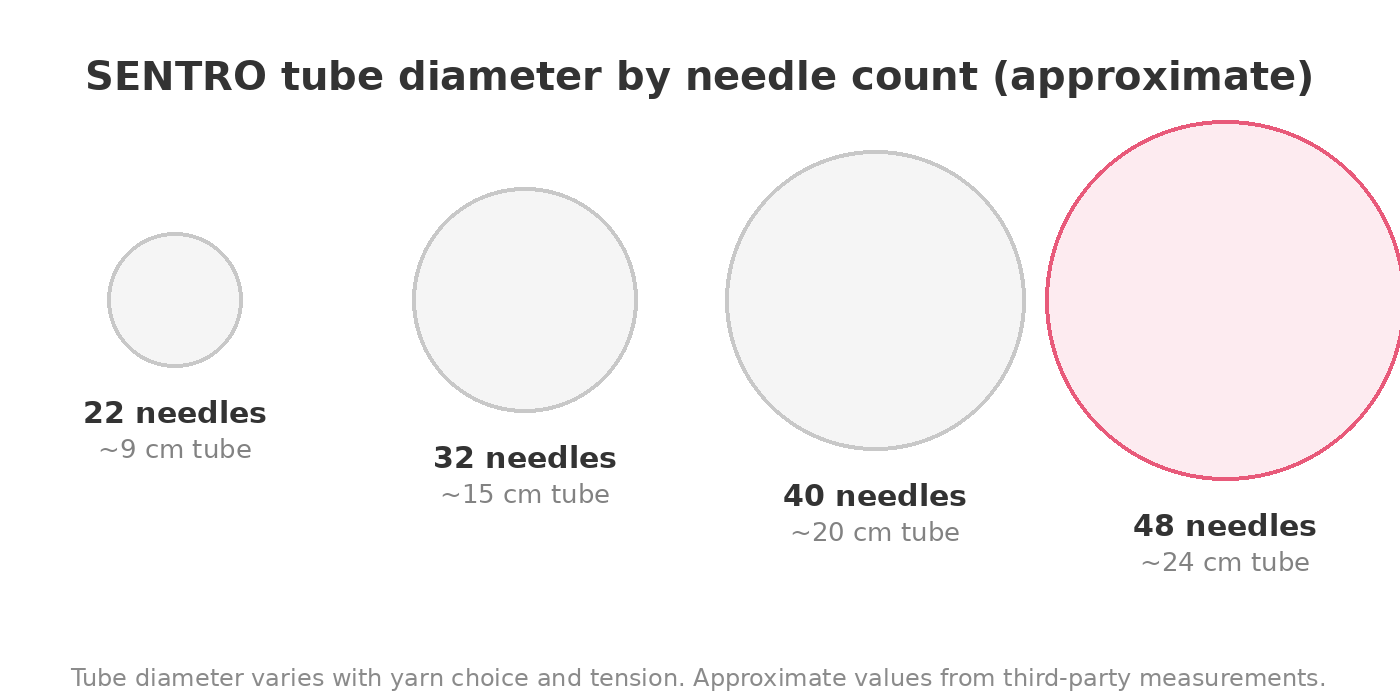
| Tube diameter | approx. 20 cm (7.9 in) | approx. 24 cm (9.4 in) |
| Flat panel width | approx. 26 cm (10.2 in) | approx. 32 cm (12.6 in) |
| Row counter | Not included as standard | Built in |
| Tension settings | 3 | 4 |
| Yarn thickness range | approx. 1.5–4 mm | approx. 1.5–4.5 mm |
| Price in our store | $49.99 | $54.99 |
Diameters and panel widths are approximate third-party measurements, not factory-published specifications.
Everything else is shared: the same hand crank, the same tube (T) and panel (P) modes, the same yarn family, and the same learning curve. The eight extra needles on the 48 buy you width — about 4 cm (1.6 in) across the tube — not a different or more complicated machine. That width sounds minor on paper. In practice it decides which heads the tube fits and how many panels a big project takes, which is why it drives almost every difference below.
What That Size Gap Means, Project by Project
| Project | 40 Needle | 48 Needle |
|---|---|---|
| Adult beanie | Runs small — sized for smaller heads | ✔ The standard choice; adult patterns are written for it |
| Kids’ and teens’ hats | ✔ Right-sized | Comes out roomy and slouchy |
| Scarves (tube mode) | Narrower, lighter scarf | Wider scarf; patterns exist for both |
| Blankets (panel mode) | ~26 cm panels — more panels, more seams | ~32 cm panels — fewer panels, fewer seams |
| Sweaters (panel mode) | Workable for kids’ and smaller sizes | Adult sizes are realistic |
| Socks | Not its job | Not its job either — see the 22 needle |
Two examples show how the numbers play out. A widely used double-layer adult beanie pattern on the 48 works about 100 rows in total and comes off the machine ready to fit an adult head; run the same idea on the 40 and the finished hat simply fits a smaller person — no tension setting changes the tube it was knitted on. For a blanket, panel width turns directly into sewing: at roughly 32 cm per panel instead of 26 cm, the 48 gets you across a throw in fewer pieces, and every panel you skip is a seam you never have to sew or hide.
Neither machine knits noticeably “faster” — both are hand-cranked at whatever pace you turn. Where the 48 saves time is finishing: fewer panels to join on larger projects.
Who Should Buy the 40 Needle
Choose the Sentro 40 needle machine if:
- It is a first machine for a child or teenager, sized for the hats and headbands they will actually make
- Your project list is headbands, ear warmers, kids’ hats, cuffs, and small accessories
- You knit now and then and would rather have the machine that matches small projects than pay for width you won’t use
- Storage space matters — it is the smaller machine on the shelf as well as on the head
Don’t buy it wrong: if adult beanies are the project you are dreaming about, skip the 40. Its tube is sized for smaller heads, the hats will come off tight, and no technique fixes a tube that starts out too small. That mismatch — not quality — is the main reason a 40 ends up being replaced by a 48.
Who Should Buy the 48 Needle
Choose the Sentro 48 needle machine if:
- Adult hats and scarves are your main projects — this is the machine those patterns assume
- You want to move on to blankets and sweaters: at roughly 32 cm per panel, adult-sized pieces are realistic without endless seaming
- You knit in batches — gifts, market stock, matching sets — where the built-in row counter makes it easier to keep repeated pieces the same length
- You are a beginner who plans to grow: the learning curve is identical to the 40, so there is no skill penalty for starting on the bigger machine
Don’t buy it wrong: don’t buy the 48 for socks — socks need a narrow tube, and that is the 22 needle’s job. And if the machine is purely a young child’s first craft tool, the 48 is more machine, and more money, than those projects need.
Price and Value: Is the 48 Worth $5 More?
In our store the 40 is $49.99 and the 48 is $54.99 — a difference of exactly $5. For that $5 the 48 adds eight needles, about 4 cm of tube width, the built-in row counter, and a slightly wider yarn thickness range.
Our honest advice: at a $5 gap, let your project list decide, not your budget. The expensive mistake is not the extra $5 — it is buying the wrong size and eventually buying twice. The 40 is the smarter purchase when your projects are genuinely small: not because it is cheaper, but because a smaller tube is the correct tool for kids’ hats and headbands, and the “savings” of the 48’s headroom are worth nothing if you never knit adult sizes.
One more option on the same shelf: the 48 needle Upgraded version ($79.99) adds a table clamp for a fixed work position. It knits the same 48-needle tube; the premium is for the clamp setup, not for knitting capacity.
A Quick Word on Yarn
Both machines are happiest with the same yarns. The manufacturer recommends medium weights — DK, worsted, and Aran — and warns that very thin yarns tend to drop stitches while bulky yarns can jam the machine. Within that range, smooth, even yarns run best on both. The only difference: the 48’s range extends slightly thicker (up to about 4.5 mm, vs. about 4 mm on the 40), which gives it a bit more tolerance for heavier worsted yarns. For the full weight-by-size chart and a tested brand list, see our guide to the best yarn for a Sentro knitting machine.
Frequently Asked Questions
Which one is better for beginners?
Both — they work identically, so the first week feels the same on either. The real question is what you will knit in month three. Beginners aiming at adult hats, scarves, and panels are usually happier long-term with the 48; for a child’s first machine, the 40 is the better-sized start.
How many rows for a beanie on the Sentro 48?
A widely used double-layer adult beanie pattern works about 100 rows in total. Your exact count will move with yarn weight and head size, so treat 100 as a starting reference, not a rule — and this is one job where the 48’s built-in row counter genuinely helps, because the two layers should match.
Can the Sentro 48 knit socks?
Not comfortably. Socks need a narrow tube, and in this range that is the 22 needle’s job — it is the size socks and baby shoes are made on. On a 40 or 48 you can panel-knit slipper-style pieces that are sewn together, but for true tube socks, choose the 22.
Does the 40 needle machine have a row counter?
Not as standard — of the two, the 48 is the model with the built-in row counter. Some third-party listings advertise a counter on 40-needle machines, so check the exact product before you buy. If you knit on the 40, a notebook or a tally app on your phone does the same job.
Can both machines use the same yarn?
Almost entirely, yes. Both run best on smooth DK and worsted yarns. The 48 tolerates slightly thicker yarn (up to about 4.5 mm), while on the 40 it is safer to stay at the lighter end of worsted. Neither machine is built for bulky (#5 and up) yarn.
The Bottom Line
Pick the 40 needle for kids, teens, and small accessories; pick the 48 needle for adult hats, scarves, and panel projects — and since the difference is $5, let the projects decide. You can compare both, along with every other size, in our Sentro knitting machine collection.


One thought on “40 Needle vs 48 Needle Knitting Machine: Which One Should You Choose?”