

A Sentro drops a stitch when the yarn fails to seat fully over a needle hook and slip off cleanly — and in practice that comes down to a short list of causes: tension set wrong for the yarn, a yarn that is too thick, stiff, or splitty for the machine, not enough downward weight in the first rows, cranking too fast or unevenly, or one problem needle. The good news is that each cause leaves a different pattern of damage, so you can usually identify yours from the symptom before you touch a setting.
Quick Diagnosis: Match the Symptom First
| If you see this… | Most likely cause | Check first |
|---|---|---|
| Stitches drop at random positions | Tension doesn’t match the yarn | Tension setting, then yarn feed |
| It only happens with one particular yarn | Yarn too thick, stiff, or textured for the machine | Swap to a smooth #3 DK or #4 worsted as a test |
| Holes and loose loops in the first rows | Cast-on rows not seating; not enough weight | Waste yarn start + hand-check the first 5 rounds |
| The same needle position drops every round | That needle: fiber stuck in the hook, bent needle, worn latch area | Inspect that one needle closely |
| Two stitches merged into one (a “tucked” stitch) | Cranking too fast, or one needle skipped | Slow down; back-crank past the tuck and re-knit |
| Crank grinds, clicks, or feels stuck | Tension far too tight, or yarn tangled in the path | Stop. Never force it — loosen tension one notch and check for a snag |
Cause 1: Tension That Doesn’t Match the Yarn
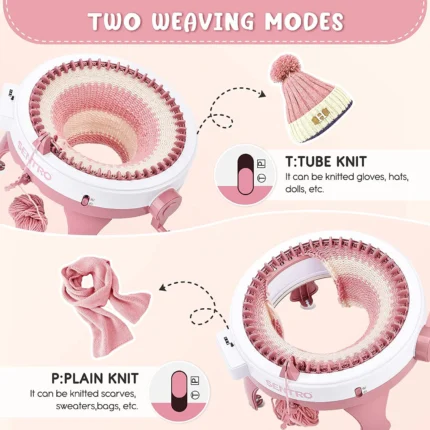
Tension is the first thing to check because it interacts with everything else. The Sentro tensioner offers several settings (four on the 48-needle, per the manual), and the right one depends on the yarn in your hand — not on a universal “correct” hole.
- Too tight is the more common beginner error. The hook struggles to pull the new loop through the old one, stitches stay riding on the needle instead of dropping, and the crank starts to feel heavy or make a grinding noise. Loosen one notch at a time and test a few rounds between changes.
- Too loose gives oversized, sloppy loops that slide off hooks before the next round secures them.
- Start in the middle. Middle tension, slow even cranking, is the baseline the troubleshooting references recommend; adjust only after a test section.
- Check the feed, not just the dial. Yarn that snags on the ball, catches on the skein band, or twists around the guide mast tightens itself mid-row even with the tensioner set correctly. The yarn should unwind freely for the whole session.
When in doubt, knit a short test tube after every tension change. Ten calm rounds tell you more than an hour of guessing.
Cause 2: The Yarn Itself
If the machine knits one yarn beautifully and drops stitches constantly with another, believe it — the machine is fine and the yarn is the problem. The manufacturer’s manual recommends medium weights — DK, worsted, and Aran — and warns that very thin yarns drop stitches while very thick ones can jam the machine. Within that range, texture matters as much as weight:
- Smooth beats textured. Even, low-fuzz yarns slide through the hooks thousands of times without catching. Bouclé, eyelash, heavily slubbed, and very fuzzy yarns are the ones users consistently blame for skips and jams.
- Splitty yarns drop “invisible” stitches. If the needle catches only part of a loosely plied strand, the half-formed stitch may hold on the machine and let go later.
- The #4 label lies. Yarns sold as “#4 worsted” vary enormously in actual thickness and stiffness. One recent support case is typical: a 48-needle owner whose machine knitted the included starter yarn with zero dropped stitches, then dropped them constantly with a store-bought #4 worsted. The fix was not a repair — it was switching to a smoother, slightly finer yarn. Weight 3, or a light weight 4, is the most forgiving zone for the 40- and 48-needle machines.
- Known quantities. Smooth acrylics such as Caron Simply Soft are the most consistently recommended test yarns across machine-knitting creators. At the other end, Caron One Pound is one of the most complained-about yarns on these machines — note that it is a completely different product from Simply Soft despite the shared brand — and stiff, scratchy yarns like Red Heart Super Saver are frequently reported to run rough and grabby, making them poor choices while you are troubleshooting.
For the full weight-by-machine-size chart and brand list, see our guide to the best yarn for a Sentro knitting machine.
Cause 3: No Weight on the First Rows
A circular knitting machine has no sinker system pulling stitches down — the fabric is drawn downward by its own weight, and a brand-new cast-on weighs almost nothing. Until the tube gets some length, stitches can ride up the needles instead of settling, and the first rows are where they escape.
- Start with waste yarn. Cast on with 5–10 rows of a smooth scrap yarn in a contrasting color. It gives the real project a finished edge to hang from and protects your first rows.
- Hang weight on the waste yarn edge. Claw weights made for knitting machines, or simple clip weights, clipped around the waste-yarn edge keep gentle, even downward pull while the tube is short.
- Move the weights up as the fabric grows, so the pull stays near the needles rather than acting on fabric far below.
- Hand-check the first 5 rounds. However carefully you cast on, watch each needle catch its yarn for the first few rounds and close any hook that missed by hand. The included starter yarn that comes with many machines is widely reported to be poor quality — it serves best as waste yarn rather than project yarn.
Cause 4: Cranking Speed and Rhythm
Speed causes two distinct faults. Crank too fast and a needle occasionally skips its yarn entirely, or catches two loops into one — the tucked stitch. Crank unevenly, speeding up and slowing down, and your tension effectively changes mid-round even though the dial never moved.
- Keep a slow, steady rhythm, especially for the first rows of a project and the last rows before binding off.
- The moment you see a stitch drop, stop. Turn back to it and lift the loop back onto its hook with a crochet hook or latch tool while it is still within reach. A drop caught now takes seconds; the same drop found after bind-off takes the rescue routine below.
- For a tucked stitch, reverse-crank back past the tuck point, then re-knit forward slowly through it.
Cause 5: The Same Needle Drops Every Time
Random drops are a setup problem. A drop at the same needle position, round after round, is a hardware problem at that one needle, and no tension adjustment will fix it:
- Look for stuck fiber. A tiny wisp of yarn wedged in the hook or hinge area stops that needle from opening and closing cleanly. Pick it out with tweezers or a needle.
- Check the needle itself. A bent or damaged needle keeps dropping or splitting stitches and should be replaced right away — knitting on with a broken needle damages the machine and guarantees more drops. Spares are inexpensive; see the replacement needles and accessories range.
- Check the foam pressure strip. A parts-supplier maintenance guide notes that the sponge strip holding the needles in position compresses over time, and advises checking it about every three months and replacing it if it has flattened below 3/8 inch (about 1 cm). A flattened strip lets needles wobble — a classic source of “mystery” drops on one section of the machine. (Single-source tip; treat as a preventive check.)
Cause 6: Lint and Missed Maintenance
Lint packs into the needle bed, the gear area, and the tension discs a little more with every project. The result is rising friction — a crank that feels stiffer than it used to, and stitches that stop seating properly. If your machine worked fine with this yarn last month and drops stitches with it now, clean before you change anything else:
- Brush the needle bed, the gear area, and the tension discs with a soft brush.
- Lubricate very lightly — a tiny amount of sewing-machine or light machine oil at the cam and nylon slider contact points is the standard advice from Sentro parts suppliers.
- Never use WD-40. It is a solvent and water displacer, not a lasting lubricant; it strips existing lubrication and leaves moving parts drier than before. And never grease gears on a schedule or open the machine to oil it as routine upkeep — light oil at the contact points, only as needed, is the verified guidance.
More detail lives in our maintenance and care guides.
Found a Dropped Stitch After the Project Came Off? The Ladder Fix
A dropped stitch does not have to mean unraveling the project. If the piece is off the machine and you find a loose loop with a ladder of horizontal strands above it:
- Lay the piece flat and find the dropped loop at the bottom of the ladder.
- With a crochet hook, work from the bottom up: catch the dropped loop, pull the lowest ladder strand through it to form a new stitch, and repeat with each strand until you reach the top.
- Secure the final loop — work it into the bind-off edge, or stitch it down with a yarn needle and a short length of matching yarn.
Watching this once is worth a page of text: Fix a Dropped or Tucked Stitch — Off Machine by Koala Knits and Knacks walks through exactly this repair.
Prevention Checklist
- Test every new yarn with a short tube before starting a real project.
- Start tension in the middle; change one notch at a time.
- Begin projects on waste yarn and weight the early rows.
- Hand-check the first 5 rounds of every cast-on.
- Crank slowly and evenly; stop the moment a stitch drops and pick it back up.
- Keep yarn feeding freely — no snags off the ball, no twists at the guide.
- Brush lint out of the needle bed, gears, and tension discs regularly; oil the cam/slider contacts very lightly, never with WD-40.
- Replace a bent or broken needle immediately instead of knitting around it.
Helpful Videos (Links Only, Creators Credited)
- How to Fix Tucked and Dropped Stitches on your Circular Knitting Machines — Calumet Knits. Best for identifying and fixing drops and tucks while the work is still on the machine.
- Sentro Knitting Machine: Advanced Techniques — Ribbing, Dropped and Tucked Stitches, I-Cord & More — Quinn Timara. Best for seeing the difference between a dropped stitch and a tucked stitch, side by side.
- Fix a Dropped or Tucked Stitch — Off Machine — Koala Knits and Knacks. Best for the rescue fix after the project is finished.
FAQ
Why does my Sentro keep dropping stitches in the same spot?
Because that needle has a local problem: fiber stuck in the hook, a bent or damaged needle, or a worn section of the foam pressure strip near it. Setup problems like tension drop stitches at random positions; a repeating position points at the hardware. Inspect that one needle first.
How do I know if my Sentro tension is too tight?
The crank feels heavy, stitches ride up on the needles instead of settling, and the machine may click or grind. Loosen the tensioner one notch and knit a few test rounds — the crank should turn smoothly and stitches should drop off the hooks cleanly. If the machine ever feels stuck, stop and check for a snag rather than forcing it.
What yarn drops the fewest stitches on a Sentro?
A smooth #3 DK or light #4 worsted, acrylic or acrylic blend, with an even thickness and low fuzz — the range the manual itself recommends. Widely reported good performers include Caron Simply Soft; widely reported troublemakers include Caron One Pound and stiff, splitty yarns. Always test a new skein with a short tube first.
My Sentro is making a grinding noise. Is that connected to dropped stitches?
Often, yes. Grinding most commonly traces back to tension set too tight for the yarn, which also prevents stitches from seating. Loosen one tension notch and check the yarn path for tangles. If the noise persists at a comfortable tension, stop and check for lint packed in the gears or a bent needle.
Do I need a different machine, or is mine broken?
Almost certainly neither. Dropped stitches are the most common complaint with these machines, and the causes are overwhelmingly setup — tension, yarn choice, weighting, and speed — rather than defects. Work through the diagnosis table top to bottom; if the same needle still drops after inspection and cleaning, that is the point where a replacement needle (or support) is the answer, not a new machine. If you are comparing models, the Sentro knitting machine range shows all four needle counts.

One thought on “Why Does My Sentro Keep Dropping Stitches? Causes, Fixes, and Prevention”